Compounding Impact
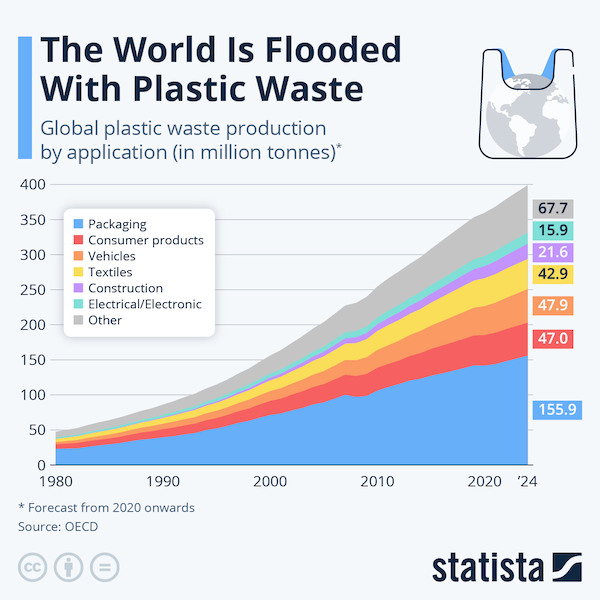
Global plastic production reached 413 million tonnes in 2023, growing at an average annual rate of 4–5%, despite widespread efforts to reduce single-use plastics. Of this volume, only 37 million tonnes are recycled each year, while approximately 226 million tonnes are landfilled, 91 million tonnes are mismanaged, and 78.5 million tonnes are incinerated. Even at a moderated growth rate of 2.5% CAGR, global plastic production is projected to double by 2050.
The Samsara GUP system and its flagship product, EcoBrik, deliver environmental benefits through a multilayered approach. Rather than solving a single issue, the system creates a "compounding impact" by addressing waste management, resource preservation, and carbon reduction simultaneously.
Low Carbon Industrialization
CO₂ Emission Reduction From Replacement of concrete bricks
Global cement production reached approximately 4 billion tonnes in 2024, generating billions of tonnes of CO₂ emissions annually. Replacing conventional concrete bricks with EcoBrik reduces CO₂ emissions through multiple pathways, compounding EcoBrik climate impact.
EcoBrik does not contain any cement. Each concrete brick replaced reduces CO₂ emissions by 0.54 kg CO₂e (540 gCO₂e).
CO₂ Emission Reduction From avoiding incineration
Only 19% of PW is currently recycled annually, as much of the collected material is contaminated, difficult, or uneconomic to recycle. As a result, approximately 50% of all PW generated is landfilled. In North America, PW incineration is expected to increase as landfills rapidly approach end-of-life and plastic occupies a growing share of available capacity.
For our carbon impact calculations, we operate on the baseline assumption that our specific feedstock—industrial mixed-plastic waste—would otherwise be sent to incineration, which is the predominant disposal route for non-recyclable streams in North America. By diverting this plastic waste from combustion to produce EcoBriks, we deliver a significant climate benefit, avoiding approximately 2.00 tonnes of CO₂e for every tonne of plastic diverted.
CO₂ Emission Reduction During Transportation
EcoBrik is 50% lighter than a concrete brick of the same size. Considering height and load limitations of a 40' container, twice as many EcoBriks can be transported in one shipment, significantly reducing CO₂ emission reduction during transportation.
Strict, Audit-Ready Accounting
To prevent double-counting, our carbon assessment strictly excludes "Virgin Plastic Avoidance" credits. We claim displacement credits only for avoided concrete production and avoided waste incineration. This conservative approach ensures our Carbon Negative claims remain rigorous, verifiable, and aligned with ISO standards.
*Note: The net reduction of 1.86 kg CO₂e per unit is based on our Vancouver facility utilizing a low-carbon hydroelectric grid (0.011 kg CO₂e/kWh). Deployment in regions with different grid emission factors will alter the manufacturing baseline.
Long-Term Carbon Storage
Samsara directly removes non-recyclable PW from the environment, effectively sequestering PW into a high-density construction material.
Enhancing Landfill Longevity
By transforming plastic and non-ferrous waste into functional resources, Samsara significantly extends the operational lifespan of existing landfills. This intervention is critical given the current waste landscape:
- Waste Composition: Plastic waste currently accounts for 20% of landfill volume, a figure projected to rise without proactive reduction strategies.
- The Capacity Crisis: Regions like the Northeast U.S. and Ontario are facing a dire shortage of disposal space.
- Economic Relief: Every year of extended landfill life delays the need for hundreds of millions of dollars in capital investment required to site and construct new facilities.
City Scale Impact
By keeping non-recyclable materials in a continuous lifecycle, the system drastically reduces localized emissions footprints.
Additional Environmental Benefits
In addition to CO₂ emissions reduction and Landfills life extension impacts, the GUP manufacturing delivers other environmental benefits.
Manufacturing Environmental Impact
Our modular production facilities deliver significant environmental benefits through efficient processing and waste reduction.
Plastic Diversion
CO₂ Avoidance
Low Leachate
While traditional recycling plants in the UK have been found to leach up to 6% of processed plastic, Samsara's GUP offers a significantly cleaner alternative.
Comparative Environmental Impact
- Dry Manufacturing Process: Unlike traditional methods, Samsara's GUP is a dry process that requires no water, eliminating water-based plastic discharge.
- Minimal Emissions: The manufacturing process releases insignificant gases, maintaining high air quality standards.
- Superior Leachate Resistance: Independent testing following EPA 1315 standards confirms that EcoBriks exhibit extremely low leachate levels of only 0.0017% over the prescribed testing period.
Natural Resources
Join the Circular Economy
Learn how EcoBrik can contribute to your sustainability goals and carbon reduction targets.